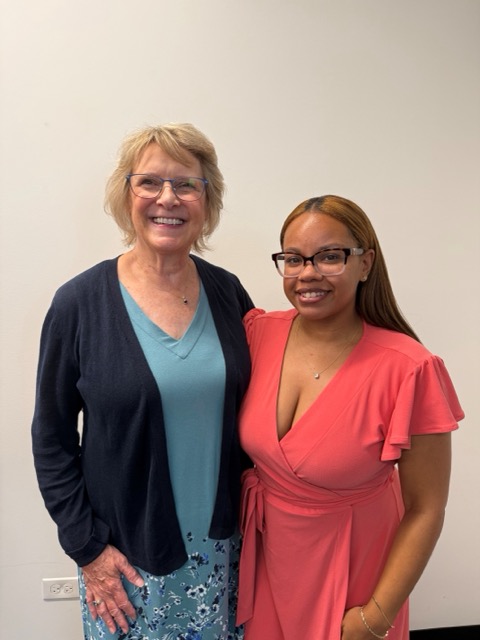
CWIP’s Women’s Leadership Mentoring Program (WLMP) is a one-year opportunity that pairs a racially and ethnically diverse group of professionals with mentors and mentees from a variety of nonprofit fields with different types of job responsibilities, professional experiences, and career goals. As the 2025-2026 program was coming to a close this summer, we asked Karol Dean and Jeneen Thomas to talk about their experience.
What made you join the WLMP program?
JENEEN
I found myself wanting to just kind of pour into my own continued education and growth and leadership. I didn't really come in with like -- I want to do this specific thing by the end of this program. I just knew I wanted to get started on some things.
KAROL
The mentoring I've experienced has been like bits and pieces and I felt like this is an opportunity to have a more structured or focused approach, and to say what is not always said. What I think has been valuable for me in working within the context of women's leadership and women's mentoring has been that we're operating under a different set of rules, and it's helpful to be able to talk about that.
What’s the benefit of having a mentor outside of your workplace?
JENEEN
I really feel like it just allows me to focus on me. If I choose to identify things that I can take back to my workspace, that's my choice, but it is not immediately rooted in whether or not this will impact the work that I do. It allows me time and space to just focus on personal and individual goals.
KAROL
It allows for so much more ability to explore. Having mentoring that's outside of a person's workplace is really, I think, a vital element of how people function well in the context of a mentoring relationship. I think that that's one of the elements of the program that is built strongly.
Tell us about each other. What have you learned about and from each other?
KAROL
Jeneen is so competent, you could lose track of the caring center that is who she is in all the great work that she produces. You could just say, oh, look, there's like a really high-powered woman, which is of course true, but at her center is a person who wants to mentor others and sees that as one of the important roles in her life.
JENEEN
Karol is a lifelong learner. She made it very clear that she fully anticipated learning from me as well in this process. I think that that's a superpower because it keeps you present. It allows you to actually show up in spaces for people if you continue to position yourself to learn new things versus just being stuck in whatever you already know.
KAROL
I think one of the things I've been learning from Janine is that she prioritizes and trusts her own vision and her own priorities in her professional life. I’m going to blame it on my generation, but it could just be me - this was just not something that was part of how I ever saw my professional role when I was doing more higher-powered work. That's been a really important lesson for me to learn by observation, to see how Janine handles it.
JENEEN
Karol has been very supportive of my ability to get things started, dip my toe into certain areas. She shared a lot of knowledge that she's had around higher education, things that I've been interested in exploring. And she's been consistent. She held me accountable where it needed to be. And has just always been available.
What have you found that the two of you have in common that might have been surprising?
KAROL
We both love structure. We're both people who are sort of pressured a little bit by structure. And we both have a really strong interest in mentoring. I've been participating in mentoring in various formats for probably the last 15 or 20 years of my life, and this is the focus of where Jeneen wants to go - to develop a consulting business that is focused on mentoring.
JENEEN
We thrive on structure and we almost seek it out or create it, right? If it isn’t there, we’re going to make it. But I also think we both oddly have a very carefree spirit to us, like in our language, in our speech. We're not worried about saying the right thing or the wrong thing or even what that looks like. And I was surprised by that. We can just talk and get the point out. We're not hung up on posture in our check-ins.
KAROL
I think women get told a lot to not to be who you are or want to be in the workplace, certainly women of color experience that. There are certain defined roles that women of color are invited to, well, I shouldn't say invited, are expected to meet. And Janine's like -blow that all up - we're just doing what we want to do. This is among the things that's brilliant about her.
JENEEN
Like Karol was talking generationally, I was raised in a way that you go to work, you just do the work. You're not there to make friends-you put your head down, you focus, you leave home at home, you leave personal stuff at the door. I think that has created robots. I think people are beautifully flawed and that's okay. I've done the best work when I was just being myself. The people I was able to reach who had never seen themselves in certain roles or following a certain path was when I was being vulnerable and transparent. How much greater impact could we make in this world if people could just focus on the work instead of on a persona or checking off boxes or playing a role.
What would you say to those considering the program?
JENEEN
I almost didn't do it because I didn’t know exactly what I wanted to achieve. Just do it. It's one of the best decisions I've made for myself, not just in my career, but for me, like as the individual, as a person. I would encourage people if you're thinking about it, if you're considering it, it's for a reason. So just sign up and let yourself see where it goes.
KAROL
Mentoring can bring you to do hard things with support. I really see structured mentoring programs as a gift you give to yourself. Anytime someone says there's mentoring available, you can have structured support to work on a goal. I mean, there's not a better thing in the world than that.